A candidate applies to your company on Monday.
By Friday, they still haven’t heard back.
The interview gets rescheduled twice. The recruiter asks questions already answered in the resume. The process feels repetitive, slow, and unstructured.
Eventually, the candidate loses interest.
Not because they disliked the role. But because the hiring experience itself created doubt.
This happens more often than most companies realize.
And it reveals something important:
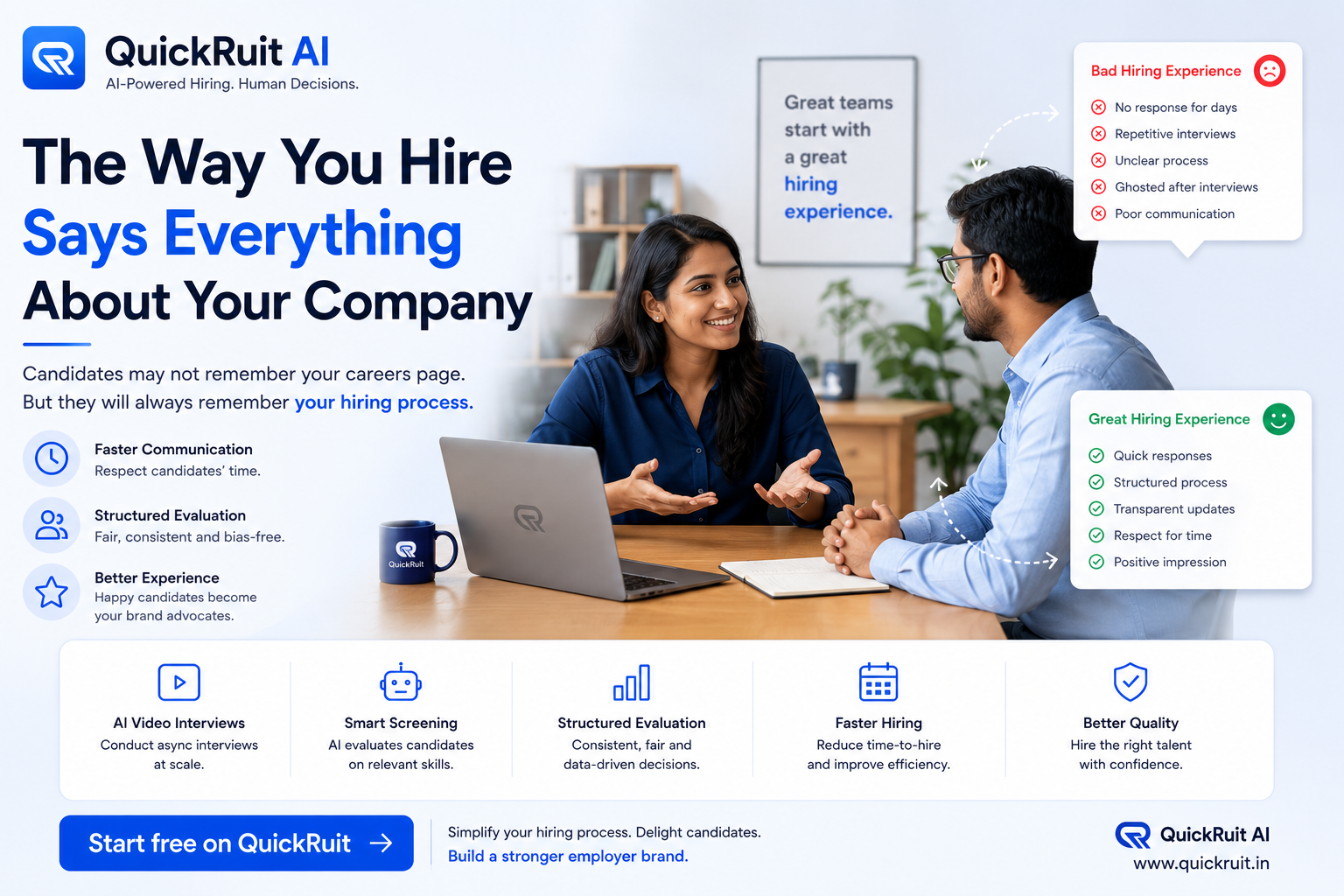
The way you hire says more about your company than your careers page ever will.
Most companies invest heavily in employer branding. They create polished websites, publish culture posts, showcase office photos, and talk about their mission and values online.
But candidates do not truly experience your company through branding content.
They experience it through your hiring process.
That is where perception becomes reality.
A company may talk about innovation, speed, and efficiency — but if candidates wait two weeks for interview feedback, the message immediately breaks.
A company may say it values people — but if candidates get ghosted after multiple rounds, the process communicates something completely different.
Hiring is not just an operational workflow anymore.
It is a reflection of how a company thinks, communicates, and executes.
And in modern recruitment, candidate experience is becoming one of the strongest competitive advantages.
The problem is that most hiring systems were never designed for today’s scale.
Recruiters are overloaded. Application volumes are increasing rapidly. Hiring teams are under pressure to move faster.
As a result, many companies operate with workflows that are heavily manual and difficult to scale efficiently.
Recruiters spend hours:
- Reviewing resumes
- Scheduling calls
- Repeating the same screening questions
- Coordinating interviews
- Following up manually
This creates delays throughout the hiring pipeline.
And candidates notice everything.
They notice delayed communication. They notice inconsistent interviews. They notice when processes feel repetitive or disorganized.
Even if the company has a strong product or reputation, a poor hiring experience creates friction before the candidate even joins the team.
This is especially important in startups and high-growth companies.
Early-stage companies often focus intensely on building products, raising capital, and scaling operations. Hiring workflows become secondary priorities.
But the reality is simple:
A bad hiring process quietly damages your brand.
Strong candidates talk to each other. They share interview experiences, timelines, and frustrations. In a connected hiring market, reputation spreads quickly.
And increasingly, candidates are evaluating companies just as much as companies evaluate candidates.
This shift is changing how modern recruitment works.
The companies attracting stronger talent today are not just offering better salaries.
They are creating better hiring experiences.
That means:
- Faster communication
- Clearer evaluation processes
- Less repetitive screening
- More structured interviews
- Better candidate transparency
The goal is not to remove human interaction from hiring.
The goal is to remove unnecessary friction.
One of the biggest problems in traditional hiring is repetition.
Candidates repeatedly answer the same questions across multiple rounds. Recruiters repeatedly conduct introductory screening calls that follow almost identical patterns.
At scale, this becomes inefficient for both sides.
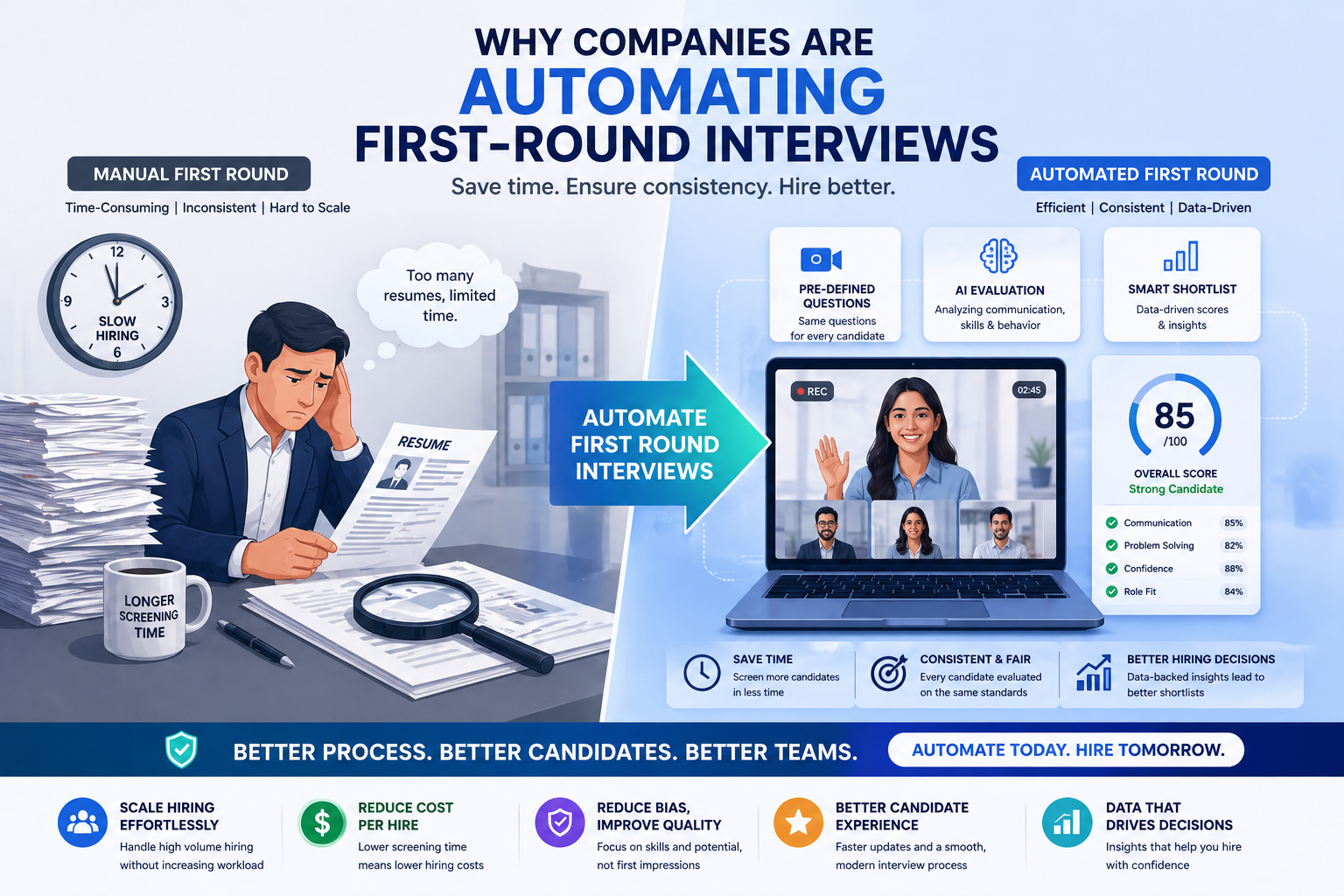
This is why more companies are moving toward structured and automated first-round evaluation systems.
Async interviews, AI-powered screening workflows, and standardized candidate evaluation are becoming increasingly common in modern hiring.
Not because companies want hiring to feel robotic.
But because hiring needs to become more scalable and consistent.
Structured systems help reduce recruiter workload while improving candidate experience at the same time.
Candidates gain flexibility. Recruiters save time. Hiring decisions become more organized and data-driven.
And perhaps most importantly:
The process starts respecting everyone’s time.
This is where hiring technology is evolving rapidly.
The future of recruitment is not about replacing recruiters with AI.
It is about helping recruiters focus on what actually matters.
Instead of spending hours on repetitive first-round workflows, hiring teams can focus more on deeper evaluation, relationship-building, and better decision-making.
Modern candidates expect speed, clarity, and structure.
If companies cannot provide that experience, strong candidates will simply move toward organizations that can.
That is why hiring process design is becoming a business advantage.
A smooth, structured, and thoughtful hiring workflow communicates something powerful:
This company is organized. This company respects people. This company values execution.
And candidates notice it immediately.
The opposite is also true.
Slow communication, inconsistent interviews, and chaotic workflows create uncertainty. Even if unintentionally, they signal internal inefficiency.
In many ways, hiring is the first real interaction people have with your company.
Long before onboarding. Long before joining. Long before culture meetings or team introductions.
And first impressions matter.
Companies that understand this are starting to rethink hiring from the ground up.
They are asking:
How do we reduce delays? How do we improve candidate experience? How do we evaluate candidates more consistently? How do we scale hiring without overwhelming recruiters?
These are no longer “HR problems.”
They are growth problems.
Because great hiring systems do not just help companies recruit faster.
They help companies build trust earlier.
That trust becomes part of the brand itself.
At QuickRuit, we have been exploring this shift closely while building AI-powered hiring workflows focused on structured first-round interviews, async screening, and scalable candidate evaluation.
The goal is simple:
Reduce repetitive hiring work. Improve candidate experience. Help teams hire faster without sacrificing quality.
Because in the end, candidates may forget your careers page.
But they will always remember how your company made them feel during the hiring process.
Start free on QuickRuit: https://www.quickruit.in