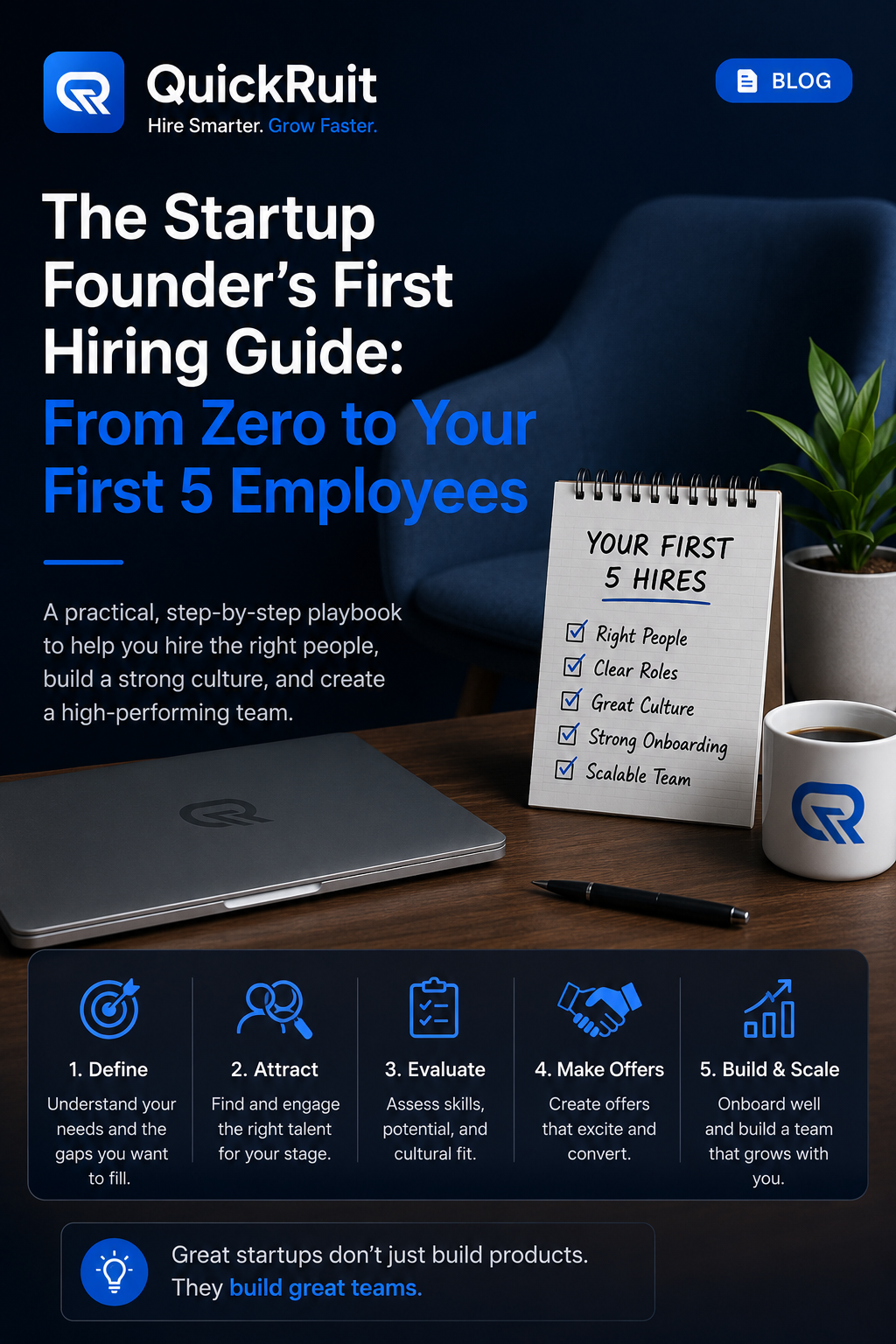
The Startup Founder’s First Hiring Guide: From Zero to Your First 5 Employees
Most startup founders obsess over their product. They spend sleepless nights perfecting the landing page, debating minor features, mapping out ambitious roadmaps, and stressing over the next release.
Honestly, it makes complete sense. In the early days, the product feels like your entire universe.
But here is a harsh reality that many founders realize far too late: Your first hires will shape your startup far more than your first few features.
Products change. Markets shift. Customers pivot. But the people you bring into your inner circle during the earliest stages become the concrete foundation on which everything else is built. If you are hiring your first employee—or building out your initial team of five—this guide will save you months of costly mistakes and structural heartbreak.
The Biggest Hiring Mistake First-Time Founders Make
Most founders hire reactively. It usually follows a predictable, stressful pattern:
- Work starts piling up to an unmanageable degree.
- Urgent customer support tickets begin slipping through the cracks.
- Core product development slows to a painful crawl.
- Demanding sales calls start filling up the entire calendar.
Suddenly, the overwhelmed founder realizes, “I desperately need help.” So they rush out a generic job post, collect a mountain of resumes, and start interviewing whoever looks decent on paper. It sounds like a reasonable response to a crisis, but reactive hiring is a breeding ground for expensive mistakes.
The absolute best time to think about hiring is before you desperately need someone. Why? Because desperation inherently lowers your standards. And early-stage startups simply do not have the margin for error to afford bad hires.
One wrong employee in a five-person company doesn’t just impact a department—they affect everyone. A bad hire doesn’t just cost you their financial salary; it costs you precious time, operational momentum, team focus, and foundational culture.
Before Posting a Job, Explicitly Define These 3 Things
Most founders completely skip the preparation phase and jump straight to posting openings. Before you even think about writing a job description, you need to have crystal-clear answers to these three critical questions:
1. What Exactly Will This Person Own?
Notice the word here is ownership, not tasks. What specific, high-level problem will they be responsible for solving?
- The Bad Way (Task-Oriented): “Build website pages, update the database, and attend team meetings.”
- The Better Way (Ownership-Oriented): “Own, streamline, and improve the candidate onboarding experience from end to end.”
Ownership naturally creates deep accountability. A task list, on the other hand, just creates confusion and micromanagement.
2. What Does Success Look Like After 90 Days?
If you cannot define what winning looks like, your candidates stand zero chance of achieving it. A great hire should enter your company knowing exactly how their performance will be measured. Clear expectations prevent early misalignment.
Tangible Examples of 90-Day Success:
- Reduce customer response time by exactly 50%.
- Successfully ship two major product releases.
- Generate 100 highly qualified inbound leads.
3. What Kind of Person Thrives in Your Startup?
Hiring for an early-stage startup is fundamentally different from corporate hiring. You don’t need a highly specialized cog in a massive machine. You need individuals who possess a specific startup mindset:
- High Learning Velocity: The ability to pick up new concepts and frameworks quickly.
- Radical Independence: Comfort working autonomously without a manager constantly looking over their shoulder.
- Extreme Clarity in Communication: Keeping the team aligned without unnecessary corporate bloat.
- High Ambiguity Tolerance: The mental resilience to handle shifting priorities and market uncertainty.
- Proactive Initiative: Spotting a problem and fixing it without waiting for an explicit assignment.
Skills can always be taught, but a startup mindset is nearly impossible to change.
Why Most Startup Job Descriptions Utterly Fail
Many startup job descriptions read less like real jobs and more like impossible corporate wish lists: Three years of hyper-specific experience, mastery of five different complex technologies, an MBA preferred from a top-tier school, excellent communication, a natural leadership background, a growth mindset, and prior startup exit experience.
The result of this approach? You scare away highly competent, adaptable builders who think they aren’t “qualified,” and you end up attracting professional resume optimizers who know exactly how to game the system.
Instead of writing a laundry list of demands, focus your job descriptions entirely on outcomes. Tell your potential candidates:
- What core problem they will be trusted to solve.
- What real-world impact they will create for the business.
- Exactly what success looks like in the role.
The absolute best talent is attracted by meaningful, high-leverage challenges—not endless bullet points of arbitrary requirements.
Stop Looking For Perfect Resumes
One of the most liberating yet difficult lessons in startup hiring is this: The best resume is rarely the best employee.
A polished resume can tell you where someone sat or what company logo was on their paycheck. It cannot tell you how they actually think. It cannot reveal how they creatively solve a blocker when there is no playbook. It cannot tell you how they handle intense pressure, and it definitely cannot predict how they will perform inside a chaotic, fast-moving startup environment.
When evaluating early-stage talent, shift your focus away from prestige and look for these fundamental qualities:
- Real-world problem-solving ability
- Clear, concise, and structured communication
- Deep intellectual curiosity
- A strong, natural sense of ownership
- Exceptional learning speed and adaptability
These raw human qualities matter infinitely more than a beautifully formatted LinkedIn profile.
Build a Simple, Consistent Screening System
You don’t need complex, enterprise-grade HR software to start hiring professionally. What you actually need is systematic consistency. Every single person who applies to your company should move through the exact same evaluation funnel:
[Resume Review] ➔ [Short Questionnaire] ➔ [First-Round Evaluation] ➔ [Final Discussion] ➔ [Offer]
The primary goal here is not complexity—it is fairness and data integrity. When you evaluate every candidate differently based on “vibes” or varying conversation paths, your hiring decisions degenerate into pure guesswork. A structured hiring process produces predictable, high-quality decisions.
Why First-Round Interviews Matter So Much
Most founders waste an enormous amount of time during the initial interview phase. They ask completely different questions to different candidates, rely heavily on post-interview intuition, and find that after talking to a dozen people, everyone starts blending together in their head.
Instead, weaponize your first round by making it structured. Ask the exact same core situational questions, evaluate the exact same underlying competencies, and grade candidates against a fixed, identical set of criteria. This simple shift makes your hiring process significantly faster, highly objective, and much easier to analyze.
A Quick Thought On Startup Hiring
What Candidates Actually Care About Beyond Salary
Many founders mistakenly assume that top talent only cares about the size of their compensation package. While fair pay is non-negotiable, it is rarely the primary driver for ambitious, high-performing early employees.
When builders look to join an early journey, they are looking closely at:
- Asymmetric Growth Opportunities: The chance to fast-track their career as the company scales.
- True Autonomy & Ownership: The freedom to execute and see the direct impact of their work.
- Continuous Learning: Being challenged to solve hard problems alongside smart people.
- High Team Quality: The inspiration that comes from working with a highly capable, driven group.
- A Meaningful Mission: A deep, underlying belief that what the company is building actually matters.
- Flexibility: Work environments that respect output over arbitrary office hours.
Your first hires are taking a massive leap of faith on an uncertain journey. The best candidates want a compelling answer to one simple question: “Why should I truly believe in this company and its founders?” If you can answer that with genuine conviction, you will naturally attract elite talent.
Building a Culture Before You Think You Need One
Most startups treat company culture as an afterthought—something to be figured out after they raise a Series A or cross twenty employees.
But here is the truth: Culture is not created down the road. Culture begins entirely with employee number one.
Every single person you hire establishes brand-new standards for the company. They dictate:
- How openly and transparently the team communicates.
- How quickly and decisively tough decisions are made.
- How accountability is handled when things inevitably break.
Future employees will naturally mirror and copy these early behaviors. This is exactly why your first five hires have such an outsized, compounding impact on the long-term future of your organization.
The Goal Is Not To Hire Fast. It’s To Hire Right.
Hiring for a startup is one of the highest-leverage activities a founder will ever perform. A single great hire can completely accelerate your business growth, ship features months ahead of schedule, and lift the entire team’s energy. Conversely, a poor hire can drag down momentum, fracture focus, and slow down an entire company.
Founders who build legendary companies understand a fundamental truth: Hiring is not an administrative HR task. It is a core business strategy. The sooner you treat it with that level of respect, the stronger your startup’s competitive advantage becomes.
Final Thoughts
Your first five employees are not just workers filling seats; they are your co-builders. They will directly influence your execution speed, your company culture, your customer experience, and every single hiring decision that follows them.
Take the process seriously. Define ownership early. Focus deeply on capability and mindset over resumes. Build structured evaluation systems.
Always remember: Products evolve. Teams compound. The right team can dramatically improve an average product, but an average team will inevitably ruin a great one.
Build Your Startup Team Smarter
At QuickRuit, we are building AI-powered hiring workflows designed specifically to help startups move past traditional resumes. Our platform empowers you to evaluate candidates through structured screening tools and asynchronous video interviews.
Whether you are looking to bring on your very first employee or actively scaling your core team, the ultimate goal remains exactly the same: Identify great, capable talent faster.
👉 Explore QuickRuit: www.quickruit.in
Stop guessing. Start evaluating.