Reducing recruiter workload has become a critical challenge in modern hiring. With increasing application volumes and limited hiring bandwidth, recruiters often find themselves overwhelmed with repetitive tasks. From screening resumes to conducting initial interviews, a significant portion of time is spent on activities that do not directly improve hiring quality.
As hiring demand grows, the need to reduce recruiter workload while maintaining efficiency becomes more important than ever. However, most hiring processes are still manual, unstructured, and time-consuming. This leads to slower hiring cycles, inconsistent evaluation, and burnout among hiring teams.
The core problem lies in how the initial stages of hiring are handled. Recruiters spend hours reviewing resumes, scheduling calls, and conducting first-round interviews that follow the same pattern for every candidate. This repetition not only consumes time but also reduces focus on high-value decision-making.
To reduce recruiter workload effectively, the hiring process needs to move toward automation and structured evaluation. Instead of handling every step manually, teams can automate first-round interviews and screening processes. This allows recruiters to shift their focus from repetitive tasks to strategic decision-making.
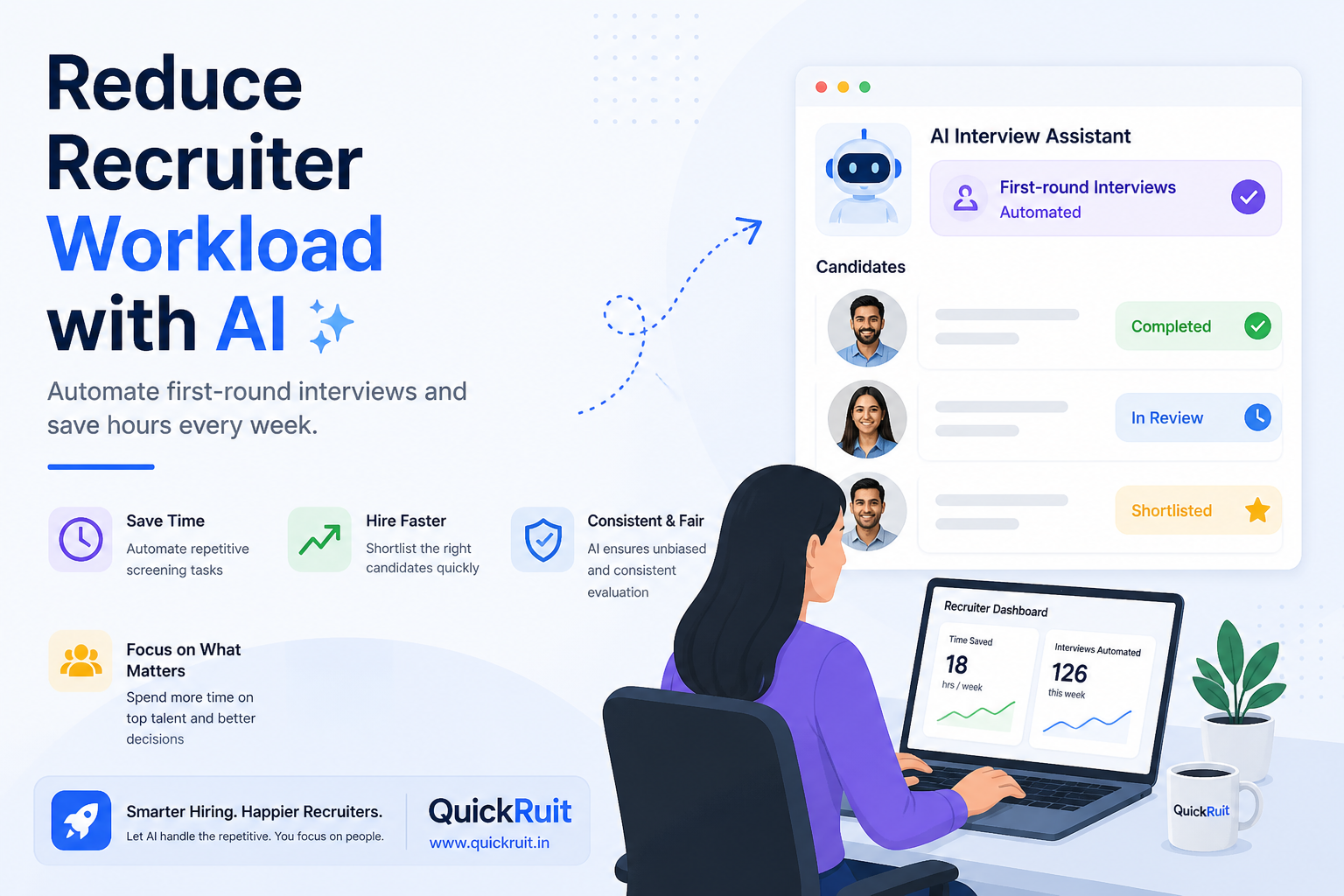
Automating first-round interviews plays a key role in high-volume hiring scenarios. Candidates can complete structured interviews at their convenience, while recruiters review responses in a standardized format. This removes the need for back-to-back screening calls and significantly reduces time spent on initial evaluation.
AI-powered hiring systems further enhance this process by analyzing candidate responses based on predefined criteria. This ensures consistent evaluation across all candidates and eliminates variations caused by manual judgment. As a result, recruiters can make faster and more reliable shortlisting decisions.
Reducing recruiter workload is not about replacing human involvement in hiring. It is about optimizing where human effort is applied. When repetitive tasks are automated, recruiters can focus on deeper evaluation, better candidate experience, and faster decision-making.
The shift toward recruitment automation is becoming a key trend in modern hiring. Companies adopting AI-driven hiring solutions are able to manage high application volumes, improve efficiency, and reduce operational strain on hiring teams.
In high-volume recruitment environments, efficiency is no longer optional. It is essential. Reducing recruiter workload through automation not only improves productivity but also leads to better hiring outcomes.
If you are exploring ways to streamline your hiring process, solutions like QuickRuit are focused on automating first-round interviews and simplifying candidate screening for modern hiring teams.