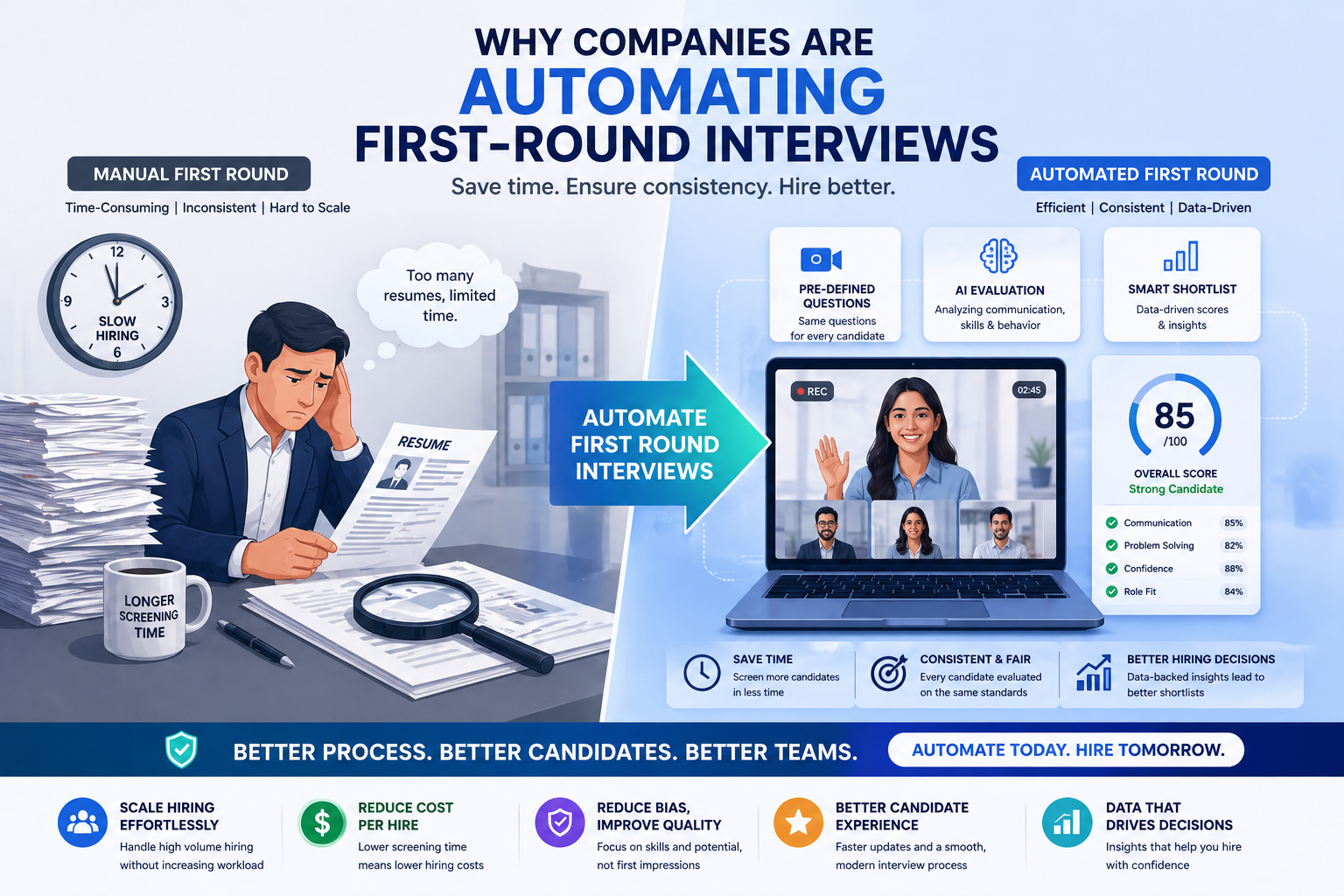

Hiring today is a race against time.
The longer your hiring process takes, the higher the chances of losing top candidates. But rushing the process often leads to poor hiring decisions.
So the real challenge is not just speed.
It’s this:
How do you hire faster without compromising on quality?
Why Time to Hire Matters More Than Ever
In a competitive job market, top candidates don’t stay available for long.
Most skilled professionals:
- apply to multiple companies
- receive multiple offers
- make decisions quickly
If your process takes too long, you’re not just slow — you’re irrelevant.
Companies often lose great candidates not because they rejected them, but because they couldn’t move fast enough.
The Real Problem: Broken Hiring Workflows
Most hiring delays are not intentional.
They come from:
- manual resume screening
- unstructured interview processes
- poor coordination between teams
- delayed feedback loops
Each step adds friction.
And friction increases time to hire.
Speed vs Quality: The Biggest Hiring Myth
Many companies believe:
“Faster hiring = lower quality hires”
That’s not true.
The real issue is not speed — it’s lack of structure.
When your process is unstructured:
- faster decisions feel risky
- slower decisions feel safer
But structured systems allow both: 👉 speed 👉 and accuracy
What Actually Reduces Time to Hire
Instead of rushing, smart companies optimize their process.
Here’s how:
1. Move Beyond Resume Filtering
Resumes don’t always reflect real skills.
Relying only on resumes:
- slows down screening
- increases wrong shortlists
Skill-based evaluation speeds up decision-making.
2. Standardize Your Interview Process
When every interviewer follows a different approach:
- decisions get delayed
- comparisons become difficult
Structured interviews bring clarity and consistency.
3. Reduce Decision Layers
Too many approval steps slow everything down.
Faster hiring requires:
- clear ownership
- faster decision authority
4. Improve Communication Speed
Delayed emails = lost candidates.
Quick updates keep candidates engaged and interested. (Speed is a crucial part of the new candidate experience advantage).
5. Use Technology to Remove Bottlenecks
Manual processes don’t scale.
Modern hiring platforms help:
- automate screening
- streamline workflows
- reduce delays
- maintain consistency
This is where companies start seeing real improvements.
The Smart Way Forward
The goal is not to hire faster.
The goal is to remove inefficiencies.
When you eliminate:
- delays
- confusion
- inconsistency
Speed becomes a natural outcome.
And quality improves automatically.
Where Modern Hiring Platforms Fit In
As hiring grows, managing everything manually becomes difficult.
This is where platforms like QuickRuit AI come into play. (To see exactly how to implement this at scale, refer to our Ultimate Guide to AI-Powered Interviews).
They are designed to:
- reduce hiring time
- improve candidate evaluation
- streamline interview workflows
- and maintain consistency at scale
Not by replacing recruiters — but by making their decisions smarter and faster.
Final Thought
You don’t need to choose between speed and quality.
That’s a false trade-off.
With the right approach and tools, you can achieve both.
Because in today’s hiring landscape:
The fastest smart decision wins.