The 10 Most Common Hiring Mistakes Indian Startups Make (And How to Avoid Them)
For an early-stage startup, every single hire can make or break the company. While large corporations can afford to absorb the cost of a bad hire, a startup simply cannot. A misaligned team member drains your runway, disrupts your culture, slows down execution, and delays your product roadmap.
In India’s increasingly competitive startup ecosystem, hiring has become one of the biggest growth challenges. Founders spend months building products, raising capital, and acquiring customers, yet many still underestimate the impact of a broken hiring process. The reality is simple: great companies are built by great teams.
Despite the high stakes, many Indian startup founders fall into the same predictable hiring traps while scaling their teams. Here are the 10 most common hiring mistakes startups make—and the practical strategies to avoid them.
1. Hiring Only Through Referrals
In the early days, tapping into your personal network is necessary. It is fast, free, and feels safe. However, relying exclusively on referrals as your company grows creates a massive blind spot.
The Problem
It creates an echo chamber. You end up building a team that thinks, acts, and solves problems in similar ways. While referrals often produce trustworthy hires, they rarely maximize diversity of thought or innovation. Eventually, your immediate network also runs out.
The Fix
Actively build outbound sourcing strategies. Use LinkedIn, startup communities, engineering forums, university networks, hackathons, and modern recruitment tools to discover talent outside your circle.
2. Writing Generic Job Descriptions
Copy-pasting a job description from a large company may save a few minutes today, but it creates months of hiring pain later.
The Problem
Generic requirements such as “team player,” “self-starter,” or “5+ years of experience” attract generic applications. Top candidates often ignore boring job descriptions because they fail to communicate impact, ownership, or growth opportunities.
The Fix
Treat your job description like a sales page. Explain what the candidate will actually work on, what challenges they will solve, what technology stack they will use, and what success looks like during the first 90 days.
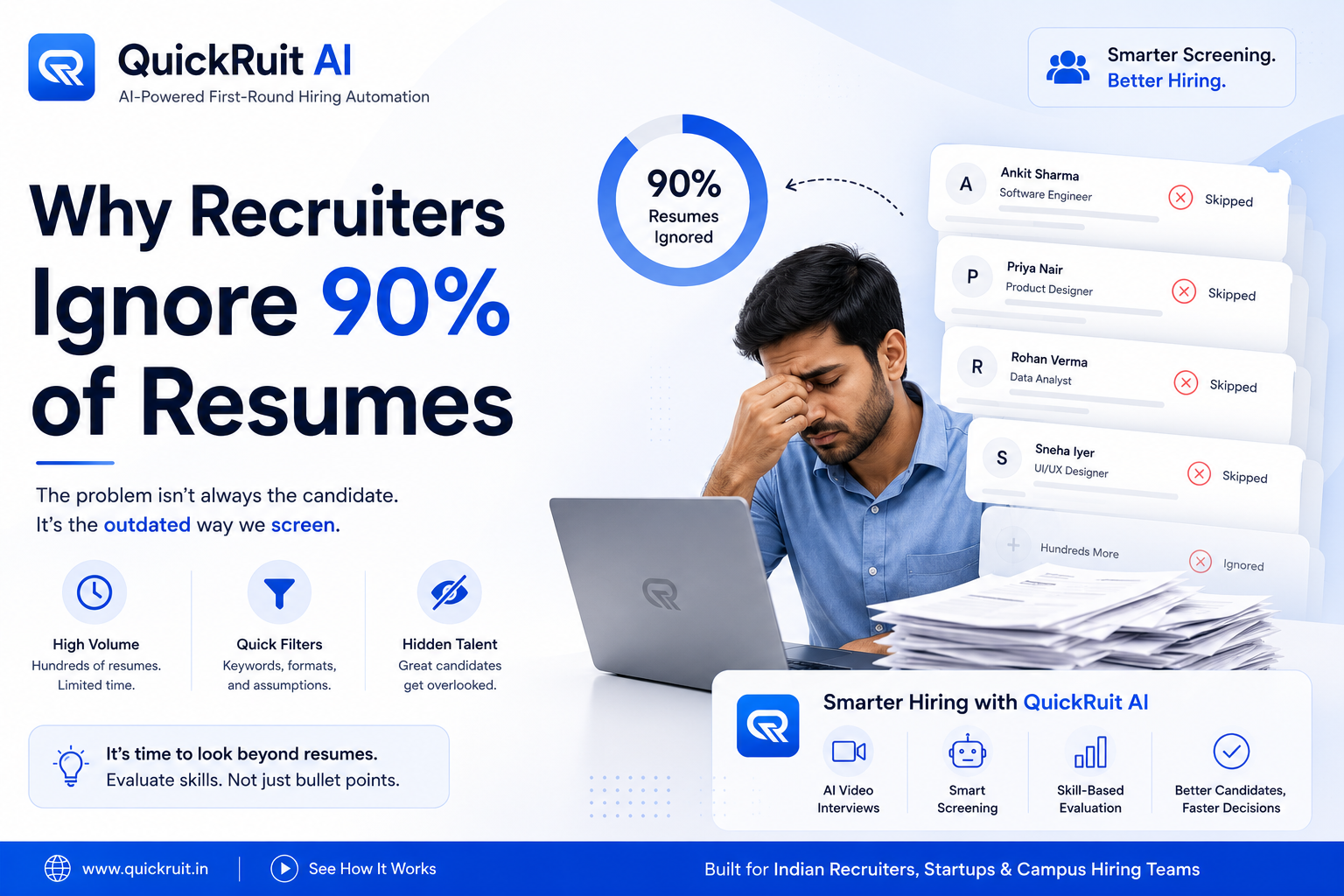
3. Screening Resumes Instead of Skills
The rise of AI-generated resumes has fundamentally changed hiring. Today, almost anyone can create a polished, keyword-optimized resume within minutes.
The Problem
A great resume does not automatically mean a great employee. Many founders waste hours interviewing candidates who look perfect on paper but struggle when faced with real-world problems.
The Fix
Move toward skill-based hiring. Evaluate actual problem-solving ability, communication skills, technical depth, and role-specific competencies before scheduling interviews.
This is exactly where platforms like QuickRuit can help. Instead of manually reading hundreds of resumes, AI-powered screening helps identify candidates based on capability rather than formatting.
4. Taking Too Long to Make Decisions
Top talent rarely stays available for long.
The Problem
Multi-week interview processes filled with scheduling delays and communication gaps almost guarantee that you will lose your strongest candidates. The best people are usually interviewing with multiple companies simultaneously.
The Fix
Condense your hiring timeline. Aim to move candidates from initial screening to final decision within 7–10 days. Startups may not have the highest salaries, but they can absolutely win on speed.
5. No Structured Interview Process
Many founders walk into interviews with no evaluation framework.
The Problem
Unstructured interviews lead to hiring based on charisma, confidence, or gut feeling rather than competence. This introduces bias and makes candidate comparisons nearly impossible.
The Fix
Create standardized interview scorecards. Every candidate applying for the same role should be evaluated using the same criteria, questions, and scoring system.
Consistency creates better hiring decisions.
6. Hiring for Experience Instead of Capability
There is a famous hiring principle:
“Hire for potential, not just for history.”
The Problem
Startups need adaptability. Someone who spent years maintaining stable systems inside a large enterprise may struggle inside a fast-moving startup environment where priorities change weekly.
The Fix
Look for learning ability, ownership, curiosity, and execution speed. Hire candidates with a steep growth curve rather than those relying solely on years of experience.
A high slope often beats a high intercept.
7. Ignoring Candidate Experience
Candidates judge your company long before they become employees.
The Problem
Ghosting applicants, delaying responses, arriving late to interviews, or assigning excessive unpaid work damages your employer brand. Negative experiences spread quickly across LinkedIn, Glassdoor, and professional communities.
The Fix
Communicate proactively. Send updates, provide closure, respect people’s time, and maintain transparency throughout the process.
Every candidate interaction shapes your company’s reputation.
8. Different Interviewers, Different Standards
Have you ever seen one interviewer strongly recommend a candidate while another completely rejects them?
The Problem
Interview panels often lack alignment. Each person evaluates different qualities, resulting in confusion and delayed decisions.
The Fix
Before opening a role, align the team on what success looks like. Define required skills, cultural attributes, evaluation criteria, and decision thresholds.
Alignment before interviews prevents chaos afterward.
9. Hiring When You’re Already Desperate
The worst hiring decisions are usually made under pressure.
The Problem
When deadlines are slipping, customers are waiting, and team members are overwhelmed, founders often lower standards just to fill a position quickly.
Reactive hiring leads to expensive mistakes.
The Fix
Always be recruiting. Build relationships with potential candidates before you urgently need them. Strong talent pipelines reduce pressure and improve hiring quality.
10. Treating Hiring as an HR Problem Instead of a Business Problem
Many founders view hiring as an operational task that can be fully delegated.
The Problem
When founders completely step away from recruiting, the company loses its hiring DNA. HR can facilitate the process, but leadership must define the talent strategy.
Every hire impacts execution, culture, customer experience, and long-term growth.
The Fix
Treat hiring as a strategic business function. Founders and team leaders should actively participate in defining requirements, evaluating talent, and building strong teams.
The best startups treat hiring with the same importance as fundraising, product development, and growth.
Quick Summary: The Hiring Blueprint
| The Mistake | The QuickRuit Fix |
|---|---|
| Referrals Only | Diversify sourcing channels |
| Generic Job Descriptions | Focus on challenges and impact |
| Screening Resumes | Evaluate real skills and capability |
| Slow Decisions | Hire within 7–10 days |
| Unstructured Interviews | Use scorecards and rubrics |
| Experience Over Capability | Hire for adaptability and growth |
| Poor Candidate Experience | Respect time and communicate clearly |
| Misaligned Interviewers | Standardize evaluation criteria |
| Desperate Hiring | Build pipelines before you need them |
| HR-Only Ownership | Founders must own talent strategy |
Ready to Build a Better Hiring Process?
Bad hires cost startups time, money, momentum, and opportunities.
The most successful startups are not necessarily the ones with the best products. They are the ones that consistently attract, identify, and retain great people.
QuickRuit helps modern startups move beyond resume screening through AI-powered candidate evaluation, structured assessments, async video interviews, and intelligent shortlisting.
Instead of guessing who might be great, evaluate who actually is.
👉 Explore QuickRuit: https://www.quickruit.in
Stop screening resumes. Start evaluating talent.