India’s Fresher Hiring System Is Broken — And Everyone Knows It
Every year, millions of students graduate from colleges across India hoping to land their first job.
Engineering graduates. MBA graduates. BCA, BBA, B.Sc., and countless others entering the workforce for the first time.
Yet despite the enormous talent pool available, companies continue to complain about talent shortages while students continue to complain about limited opportunities.
Something doesn’t add up.
If India produces one of the largest graduate workforces in the world, why are companies struggling to find qualified candidates?
The answer is simple.
The problem isn’t talent.
The problem is how talent is being discovered.
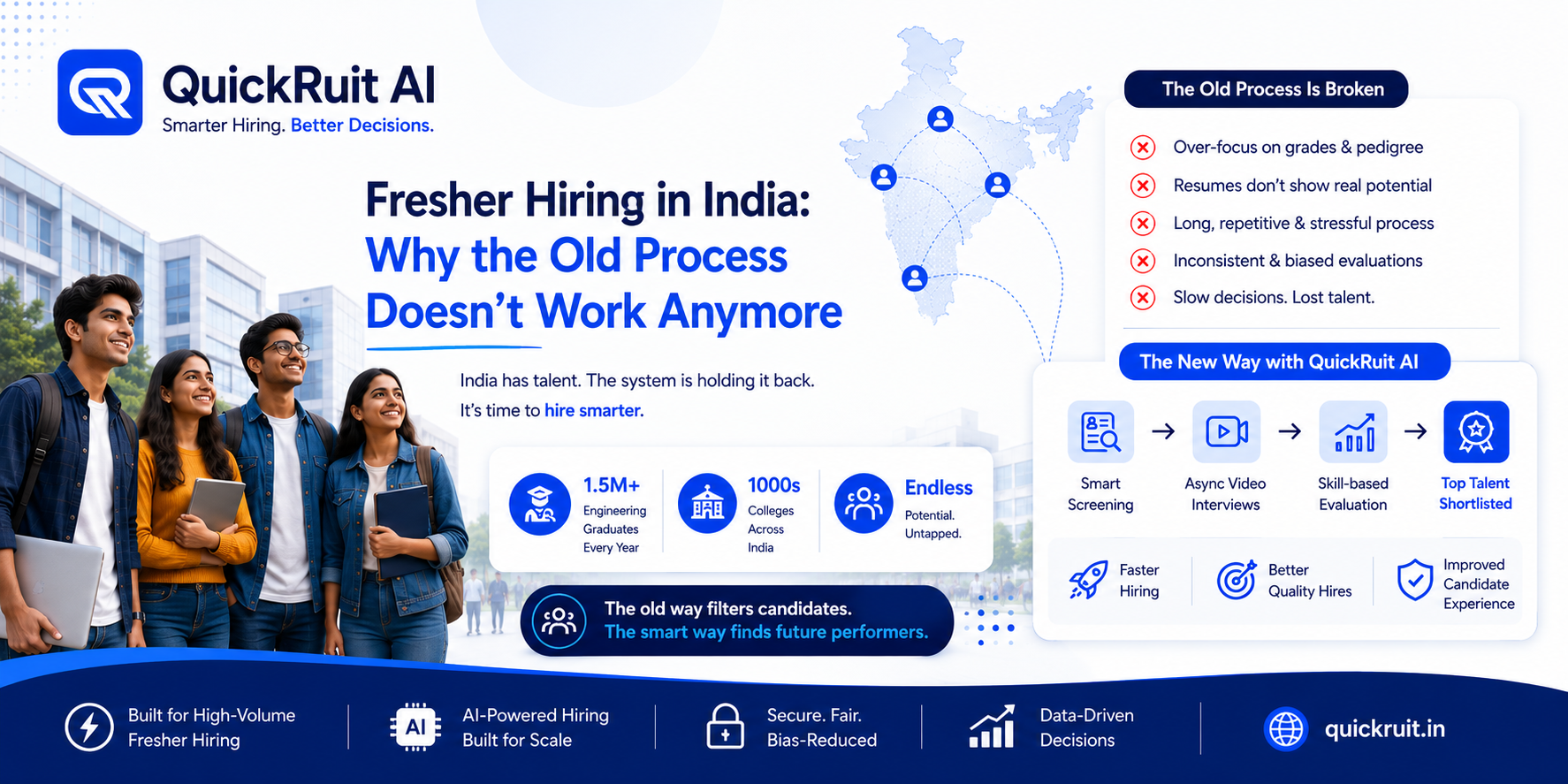
For decades, campus hiring in India has followed almost the same playbook. Companies visit selected colleges, shortlist students using academic filters, conduct aptitude tests, run interviews, and make offers.
The system worked when applicant volumes were manageable.
It doesn’t work anymore.
In 2026, the scale of fresher hiring has changed dramatically, but the hiring process has not evolved at the same pace.
The Scale of India’s Fresher Market Has Exploded
India is one of the world’s largest producers of young talent.
Every year, more than a million engineering students alone enter the job market. Add graduates from management, commerce, science, and other disciplines, and the numbers become even larger.
For recruiters, this creates a completely different challenge.
The issue is no longer finding candidates.
The issue is evaluating thousands of candidates efficiently and fairly.
Traditional campus hiring was designed around limited applicant pools.
Today’s hiring teams often receive hundreds or thousands of applications for a single fresher role.
As volume increases, recruiters naturally rely on shortcuts.
College names.
CGPA filters.
Keyword matching.
Resume screening.
The result is predictable.
Potential gets overlooked.
Why Traditional Campus Hiring Often Selects the Wrong Signals
Most hiring systems reward indicators that are easy to measure.
Grades.
College reputation.
Certifications.
Resume formatting.
The problem is that these factors do not always predict workplace success.
A student with a high CGPA may struggle in collaborative environments.
A candidate from a lesser-known college may outperform graduates from top institutions.
A well-designed resume may say very little about actual problem-solving ability.
Yet hiring teams continue to rely heavily on these signals because they are convenient.
The challenge is that convenience and accuracy are not always the same thing.
The modern workplace requires adaptability, communication, learning ability, ownership, and critical thinking.
Unfortunately, these qualities rarely appear clearly on a resume.
This is why many companies discover after hiring that the candidate who looked strongest on paper was not necessarily the strongest performer.
What Freshers Actually Want From Employers in 2026
The next generation entering the workforce is fundamentally different from previous generations.
Gen Z candidates have grown up in a digital-first world.
They are comfortable with technology.
They expect faster communication.
They value transparency.
And they are far less patient with outdated hiring processes.
Many freshers today expect:
- Faster interview feedback
- Flexible interview formats
- Transparent hiring timelines
- Skill-based evaluation
- Better candidate experience
When hiring processes become excessively slow or repetitive, candidates disengage.
The best candidates often have multiple opportunities available.
Delays create drop-offs.
This means companies are not only competing for talent.
They are competing on candidate experience.
The New Signals That Actually Predict Performance
If grades and resumes are not enough, what should companies evaluate instead?
Modern hiring is increasingly focused on signals that correlate more closely with workplace performance.
These include:
- Communication ability
- Problem-solving skills
- Adaptability
- Learning mindset
- Ownership
- Behavioral consistency
- Role-specific competency
These qualities provide a much clearer picture of future performance than traditional academic metrics alone.
The challenge is measuring them at scale.
This is where hiring technology is beginning to play a significant role.
How Skills-First Screening Is Changing Fresher Hiring
One of the biggest shifts happening in recruitment today is the move toward skills-first hiring.
Instead of asking:
“Where did this candidate study?”
Companies are increasingly asking:
“What can this candidate actually do?”
This shift benefits both employers and candidates.
Employers gain access to a larger talent pool.
Candidates gain opportunities regardless of pedigree.
Skills-first hiring focuses on demonstrated ability rather than assumptions.
This creates a more merit-based evaluation process.
It also helps organizations uncover talent that traditional screening methods often miss.
As hiring volumes continue increasing, skills-first screening is becoming less of a competitive advantage and more of a necessity.
Why Async Video Interviews Work Especially Well for Freshers
One of the most interesting developments in fresher recruitment is the rise of asynchronous video interviews.
Unlike traditional interviews that require scheduling coordination, async interviews allow candidates to complete interviews on their own time.
For freshers, this approach offers several advantages.
Many students are already comfortable communicating through digital platforms.
Video-based interaction feels natural to a generation raised on smartphones, online learning, and digital content.
Async interviews also create consistency.
Every candidate receives the same questions.
Every candidate gets the same opportunity to respond.
This reduces interviewer bias while improving fairness across large applicant pools.
For recruiters, the benefits are equally significant.
Instead of scheduling hundreds of introductory calls, hiring teams can review structured responses more efficiently.
The result is a faster and more scalable hiring process.
Watch This Video
Building a Fresher Hiring Pipeline That Scales
The companies that will win the talent race over the next decade are not necessarily the companies with the largest recruiting teams.
They will be the companies with the smartest hiring systems.
Scalable fresher hiring requires more than simply increasing recruiter effort.
It requires improving how candidates are discovered, evaluated, and shortlisted.
The future hiring pipeline looks different:
- Skills-first evaluation
- Structured screening workflows
- Automated candidate assessments
- Async interview processes
- Data-driven shortlisting
- Faster decision-making
These systems help recruiters focus less on repetitive tasks and more on meaningful hiring decisions.
Most importantly, they help organizations identify talent that would otherwise be overlooked.
The Future of Fresher Hiring in India
India’s talent pipeline is growing faster than ever before.
The challenge facing employers is no longer access to candidates.
It is access to the right candidates.
The companies that continue relying solely on resumes, college pedigree, and outdated campus hiring processes will increasingly struggle to compete.
Meanwhile, organizations adopting skills-first hiring, structured evaluation, and modern recruiting workflows will gain a significant advantage.
The future of hiring is not about processing more resumes.
It is about understanding people more effectively.
And for India’s fresher workforce, that shift cannot come soon enough.
Start Building a Better Fresher Hiring Process
At QuickRuit, we’re helping companies modernize high-volume fresher recruitment through AI-powered screening, structured evaluations, async video interviews, and intelligent candidate shortlisting.
Whether you’re hiring 50 graduates or 5,000, the goal remains the same:
Identify real talent faster.
Ditch manual screening. Build a smarter fresher hiring pipeline.
👉 Start your hiring journey with QuickRuit: https://www.quickruit.in
Find potential. Not just resumes. 🚀